#vtax Rumor
August 2, 2011 Leave a comment
Rumor has it, Wednesday August 8th, 2011 VMware is having a conference call with partners to talk about the somewhat disastrous vRAM pricing and announce some changes. We shall see…
Where servers, storage and networking combine to form Voltron.
August 2, 2011 Leave a comment
Rumor has it, Wednesday August 8th, 2011 VMware is having a conference call with partners to talk about the somewhat disastrous vRAM pricing and announce some changes. We shall see…
July 29, 2011 Leave a comment
There’s a rumor that VMware is backing away a bit from their vRAM (vtax) licensing. Nothing confirmed yet, but according to gabesvirtualworld.com, they’re not getting rid of vRAM licensing entirely, but are making some adjustments. They’re upping the vRAM allotments, and 96 GB is the maximum a VM can count towards vRAM allocation, If you had a VM with 256 GB of RAM, only 96 of it would count towards vRAM usage. I’d still like to see vRAM go away entirely, but it seems the new limits are less catastrophic in terms of future growth.
On a related note, it seems Oracle is one-upping VMware in the “dick move” department. A blog post on virtualizationpractice.com points out Oracle’s new Java 7 licensing: In virtualized environments, Java 7 only officially supported by an Oracle hypervisor. Knowing Larry Ellison, it’s not all the surprising. He’s a lock’em in kinda guy. I avoid Oracle at all costs.

VMware’s dick move was a surprise. That didn’t seem like the VMware we’d been working with for years. Oracle on the other hand, you’re only surprised they didn’t do it sooner.
July 21, 2011 Leave a comment
It looks like Riverbed is making a move into F5’s territory by acquiring Zeus. F5 has WOC (WAN optimization controllers) technology, but the last time I took a look at them (admittedly several years ago) they were pretty terrible. However F5 has the market leader for load balancing. Riverbed is known as the leader in WOCs, but until now had no load balancing capabilities.
Strong WOCs, new load balancing. F5 has strong load balancing, iffish WOC. Is Riverbed looking to be F5 with a goatee?
 Meet Riverbed
Everyone I’ve ever talked to loves the Riverbed WOCs. Their primary competitors on this space have been Cisco (with WAAS), Bluecoat, F5 (used to have WanJets, now they’re modules in the LTMs) and a handfull of others. But they haven’t had a load balancer, until now.
It makes sense, the WOC and load balancer spaces both live in that tricky realm of Layer 7 network devices. It is a realm where many network admins dare not tread. It’s tough enough keeping STP, OSPF, ISIS, let alone all the new stuff like FCoE, TRILL, DCBX, and so forth without it all bursting one’s cranial cavity like an over-ripened fruit, these products throw all those Layer 7 protocols (HTTP, IMAP, POP3, Exchange, etc.) into the mix.
To be honest, I haven’t seen a lot of Zeus in the market (while I always see F5). My impression is that, like my favorite band Pop Will Eat Itself, they’re bigger in Europe.
See press release here: http://www.zeus.com/resources/press-release/riverbed-expands-it-performance-business-acquisition-zeus-technology
July 19, 2011 8 Comments
So VMware announced last week the new vSphere 5. There were lots of new features and improvements announced, but the conversation that has resulted isn’t quite what VMware had in mind. Virtually (get it? virtually?) all discussion has centered around the new licensing scheme.
And some of us feel that the change is, well… a trap.
 For pete’s sake Tony, they’re going to take your VCP away for this
There have been many, many blog posts with people weighing in. Most of the feedback on blogs and messages boards has been fairly negative. A few have been more positive, although the positive blogs (retweeted rapid fire by a somewhat desperate-sounding @vSphere5 twitter account) have enthusiastic sounding topics like 7 Reasons Why VMware vSphere 5 vRAM Licensing Is Not As Bad As It Looks At First Glance.
My thoughts on this are it’s actually much worse than at first glance. To quote a certain raspy-voiced naval officer: “It’s a trap”.
At the heart of the change is the new concept of vRAM. vRAM is an allotment of RAM to use for powered-up VMs. If you have 10 4 GB VMs, you’d need 40 GB of vRAM allotments to power them up.
With the old licensing, you could use as much RAM as you could cram into a box. You only paid per CPU (with limits on the number of cores per CPU depending on the license). As RAM prices dropped, it made it very attractive to cram lots and lots of VMs into fewer hosts, requiring less power and cooling. Servers with 128-512 GB of RAM from Cisco, HP, and Dell are fairly common now.
With the new licensing, you pay for CPU like before, and they’ve removed any core limits. However you now get a limited vRAM allotment with each license. No more unlimited RAM. And that’s the part that’s a trap.
The @vsphere5 twitter account is busy retweeting posts from users who checked their licensing and found that to upgrade to vSphere 5, the current vRAM allotments are within the range of their physical RAM. So yeah, right now your licensing may work out and you don’t need to purchase any extra licenses, especially if you’re running on hardware more than a year old.
But what about the hardware you were going to refresh too? Chances are, it’s a nice beefy blade dripping with RAM like jewels on an heiress. And that’s when you’ll need to buy more licenses to use all that RAM.
RAM Rules Every Thing Around Me (Get the DIMMS, Y’All)
We’ve gotten used to the idea that RAM was essentially free in terms of licensing. In physical terms, RAM had a cost associated to it, but it could easily offset those costs in terms of savings with regard increased density.
The biggest issue with vRAM allotments are that they’re too small today, and they’ll definitely be too small tomorrow. RAM is a depreciating asset. RAM price continuously goes down, and servers are getting more and more of it. The issue isn’t if the new licensing model will screw you, it’s when.
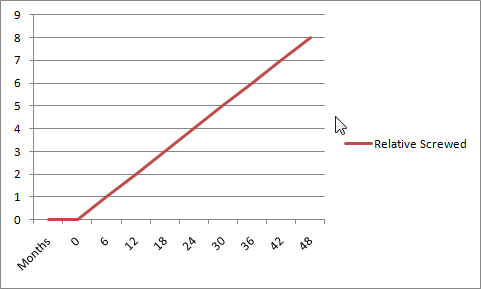
VMware’s blog post on why they made the new licensing, and they included some graphs. Well here’s a graph I came up with.
 Tony, you have a gift for visual aids.
The vRAM allotments are pretty small today, especially if you recently did a hardware refresh. Chances are if you bought a brand new 2-way server recently, it probably came dripping with RAM like jewels on an heiress.
And RAM keeps getting less and less expensive. A year or so from now, 1 TB systems (probably with no more than 2 or 4 10 core CPUs) won’t be that uncommon. And then the licensing for VMware will be really bad compared to vSphere 4.
Under current licensing, licensing a full 1TB system with 4 CPUs would cost $76,890 USD. That’s 22 licenses for a 4 CPU system.

“$76,890 a server? Our IT budgets can’t repel license increases of that magnitude!”
VMware’s Other Dick Move
I’ve already written about how VMware has dramatically changed the licensing for the free version of the vSphere 5 hypervisor (ESXi 5.0). The limit used to be 256 GB of RAM, now it’s 8 GB. Was 256 GB too much? Sure. But 8 GB is way too low.
To those of us that have home labs, that means we’ll be looking elsewhere. I think this is going to have a dramatic impact on the number of virtual appliances released for VMware. The focus will then move to XenServer (since most virtual appliances are based on Linux).
Let’s face it, this new licensing scheme (and the 8 GB limit on the free version of ESXi 5) are dick moves. Up until now, VMware has been very friendly to its customer base. Users have supported them, championed them, and advocated on their behalf. I’ve never felt the need to even look at another hypervisor, because VMware rocked it.
Now, I look at VMware like I look at vendors like Oracle and EMC. For IT managers and techies alike, we know there are some vendors where the relationship is symbiotic. We’ll sit at the same side of the table. Networking vendors like Juniper, F5, and even Cisco (with a few exceptions) take a cordial and symbiotic view of the customer/vendor relationship. Some vendors *cough Oracle cough Checkpoint couch* take a more adversarial and parasitical view.
I’m not saying VMware is quite at the level of parasitic right now, but they’ve suddenly taken a step in that direction. And that means the honeymoon is over. There is a general feeling that the loyal customer base is being taken for granted, as if somehow we owe VMware for the awesomeness they provide us. Well it’s the IT managers and nerdarati that helped make VMware the company it is today. And I can’t help but feel they’ve turned on us. One might say even say, turned to the dark side.
Look VMware, I’ve got to be honest. I’ve been… I’ve been seeing other people. I downloaded XenServer the other day. It asked me to download it, and I was being polite, but considering you might limit us to 8 GB, I went ahead and installed it. And I’m liking what I see.
A wise sysadmin once said: “Never uninstall angry”. So I’m not making any moves yet. I’m not quite ready to break up with VMware. It’s still a dynamic ecosystem, and I hope its not too damaged by all this. It’s been almost a week since the announcements so I’ve been able to get a little perspective. I’m still disappointed, to be sure, but I’m not quite as aggro.
It’s clear VMware felt it was getting the short end of the stick with the trend towards high server density. And perhaps VMware licensing needed to be changed to reflect this. I’m not all together against vRAM pools, but I do think they need to be dramatically increased. Today they’re too small, and a year or two from now they’ll be laughable.
July 19, 2011 Leave a comment
Yo dawg, I heard you like hypervisors, so I put a hypervisor in your hypervisor.

I’ve been testing out XenServer, it’s actually quite nifty. Unfortunately, I can’t run reguar VMs while running in ESXi, as it doesn’t pass on the VT-d extensions, so only paravirtualized OSes will run.
July 17, 2011 11 Comments
Update 9/8/11: Check out my guide for building/buying an inexpensive ESXi host
Update 8/4/11: Woohoo! They’ve up’d it to 32 GB of vRAM allocation (and max 32 GB of physical RAM too).
Update 7/18/11: Yes, it’s true. Here is it in writing (last FAQ entry).
Wow, this keeps getting worse and worse.
Many techies such as myself have been running ESXi 4.1 in our home labs. The free license runs full blown ESXi with some limits, such as no vmotion, no HA, no vCenter integration, etc. It’s fine for a lab environment, and perfect for a home lab where I need to test a lot of systems.
I was about to publish an article called “So You Want To Build an ESXi System?” on how to build a cheap home system. (Hint: you could build a cheap home system for about $1,000 that had 24 GB of RAM and 4 cores.)
But now, there are reports that VMware has made the free version of vSphere 5 Hypervisor (essentially it’s ESXi 5.0 renamed) absolutely useless by limiting the total amount of RAM to 8 GB per host. I’ll say that again: You can only use total of 8 GB of RAM for all your VMs on a host, no matter how much RAM it has.
8 GB? Seriously?
The licensing change for the paid version was bad enough. We used to be able to increase RAM on our licensed ESX/ESXi hosts free to increase utilization. The same went with the free version of EXSi. Below is a screenshot of my current ESXi license. I get up to 6 cores on one CPU (I have a quad-core Intel Core i7) and up to 256 GB of RAM (my host has 18 GB).
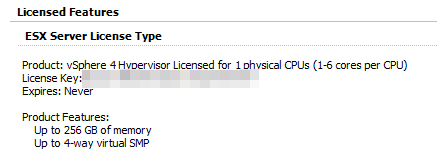 My current ESXi 4.1 free license: 256 GB limit and no more than 6 cores per CPU
Sure, 256 GB of RAM is a bit much. I’d accept a lot lower than that for a limit, I think even 32 GB would be reasonable (although it wouldn’t be reasonable for more than a few years). I’d even accept the current core limit (or maybe bump it up to no more than 8?) But 8 GB? That’s a useless home lab.
Look, VMware, I know you’re in it to make a buck. I don’t fault you for that. I like money too. I too have fantasies of swimming through a vault of gold like Scrouge McDuck.
 Our mutual shared goal
If this is true it’s a huge blow the VMware community, and given that the vRAM allocation for the lowest paid license is 24 GB, the 8 GB limit for free seems about right.
I’ve been a passionate advocate of VMware, I’m VCP4 certified, and I teach courses that involve virtualization. The only VM vendor out of my mouth for the most part has been VMware. You’ve treated the community well in the past, and we the nerd class and IT managers have rewarded you handsomely with server virtualization market dominance. A fantastic ecosystem has cropped up, and you could make a good living within the VMware world. The licensing moves challenge this. All that built-up good will? It’s quickly fading fast.
July 15, 2011 1 Comment
To clarify my post about the condition of STANDBY_COLD in the Cisco ACE, I dont’ think it’s a bug necessarily. The documentation (who reads documentation?) tells you to upload the SSL certificates and keys to both the active and standby.
The issue is that it’s easy to make the mistake of not uploading to both. Because the rest of the configuration is sync’d automatically, it’s easy to make the assumption the keys and certs are sync’d too. When you import the certs and keys there’s no warning that tells you that you should upload to both the active and standby.
And if you did make that mistake, there’s no red light that says “hey, I’m in STANDBY_COLD!”. If you don’t know to look for it, you could be in it and not know it. Also, STANDBY_COLD isn’t exactly a descriptive error state.
So it’s not a bug per say, but it is a bit tricky. It’s more of an operational bug. There should be more of an indication that the system is in STANDBY_COLD. That’s why many of my students are surprised to find that they are, in fact, in STANDBY_COLD and didn’t know it.
July 12, 2011 Leave a comment
I’d been thinking about how the ubiquity of Catalyst 6500 was impressive in many ways (always been there for me, etc.), but also how it prevents a lot of new technology adoption, such as FCoE, Fabric Path/TRILL, etc. because it doesn’t support them. And today I heard that there’s a new supervisor module for the Cat6K. On an episode of Packet Pushers, I’d heard the Cat6K referred to by Ethan as the “Old Man of the Datacenter”. So I hit up some Photoshop (or rather, GIMP), and voila.

July 6, 2011 Leave a comment
Here is a quick video on the HTTP protocol.
July 5, 2011 1 Comment
I read with great morbid curiosity the open letter to RIM from a RIM employee. In the letter, the anonymous author mentions the video below of Steve Jobs from a WWDC developers conference in 1997. It’s a fascinating video, and as the author says really does speak to RIM today as it did Apple and developers in 1997.
In this video, I watched perhaps one of the best ways for someone to deal with what I would call “The Righteous Pedant”. In IT, we’ve all probably dealt with this personality type, especially those of us that do public speaking or teaching.
At this point in 1997, and Steve Jobs had not yet taken over Apple, but he had come back into the fold after Apple had bought NeXT, one of the two companies that Jobs started after he left Apple (the other being Pixar). He did something that you don’t see a lot, in that he sat down and took frank and sometimes confrontational questions from the audience at WWDC. The entire video is a great example of a how to talk to detractors, and how to explain a controversial strategy. He’s thoughtful, respectful, and rather than counter-attack he made his case and acknowledged his fallibility.
Apple made a lot of tough decisions in those years, including killing a platform called OpenDoc. OpenDoc had the same of the same goals as Java, but Steve was involved in (his own words) putting a bullet in the head of OpenDoc. A very controversial decision at the time.
And so, during this WWDC talk, at 50:22 in the video, a very angry developer takes the mic and asks Steve this question. His tone was dripping with contempt, anger, and righteousness.
Mr Jobs, you’re a bright and influential man… it’s sad and clear that on several counts you’ve discussed that you don’t know what you’re talking about. I would like, for example, for you to express in clear terms how say Java in any of its incarnations addresses the ideas embodied in OpenDoc. And when you’re finished with that, perhaps you could tell us what you’ve been personally been doing for the past seven years.”
His answer was a brilliant, frank, and honest way to answer the question. It wasn’t the executive dodge, it made his case, and he took ownership of the decision. That’s not something you see a lot of, and it’s a great example of how to not only talk to a detractor, but do it in an honest and effective way.
 The Data Center Overlords