CCIE Data Center Dates Pushed Back

Originally, the CCIE Data Center written exam was to be available September 3rd, and the lab exams available sometime in October. It looks like those dates have been pushed back.

As of writing, the written exam will be available starting September 17th, 2012 (still isn’t live on PearsonVUE yet). The lab exam first dates will be sometime in December, 2012.

I also heard that the CCIE Data Center written beta exam results will be available at about September 15th, 2012. Like many of you, I’m constantly checking my cert tracker…

A bit disappointing, but we’ve waited this long, we can wait a few more weeks.

A Different Kind of Loop

I’m not all nerd and memes, sometimes I do stuff like this. Starting not long after I got my pilot’s license, I started doing occasional aerobatics lessons. In this clip, I’m the one flying under the watchful eye of the instructor behind me.


VMware Year-Long vTax Disaster is Gone!

The rumors were true, vTax is gone. The announcement, rumored last week, was confirmed today.

Tequila!

Don’t let the door hit you on the ass on your way out. And perusing their pricing white paper you can see the vRAM allotments are all listed as unlimited.

vRAM limits (or vTax as it’s derisively called) has been a year-long disaster for VMware, and here’s why:

It stole the narrative

vTax stole the narrative. All of it. Yay, you presented a major release of your flagship product with tons of new features and added more awesomesauce. Except no one wanted to talk about any of it. Everyone wanted to talk about vRAM, and how it sucked. In blogs, message boards, and IT discussions, it’s all anyone wanted to talk about. And other than a few brave folks who defended vTax, the reaction was overwhelmingly negative.

It peeved off the enthusiast community

Those key nerds (such as yours truly) who champion a technology felt screwed after they limited the free version to 8 GB. They later revised it to 32 GB after the uproar, which right now is fair (and so far it’s stil 32 GB). That’ll do for now, but I think by next year they need to kick it up to 48 GB.

It was fucking confusing

Wait, what? How much vRAM do I need to buy? OK, why do I need to 10 socket licenses for a 2-way server. I have 512 GB of RAM and 2 CPUs, so I have to buy 512 GB of vRAM? Oh, only if I use it all. So if I’m only using 128 GB, I only need to buy 4?  OK, well, wait, what about VMs over 96 GB, they only count towards 96 GB? What?

What?

It was so complicated, there even a tool to help you figure out how much vRAM you needed. (Hint: If you need a program to figure out your licensing, your licensing sucks.)

It gave the competition a leg up

It’s almost as if VMware said to Microsoft and RedHat: “Here guys, have some market share.” I imagined that executives over at Microsoft and Redhat were naming their children after VMware for the gift they gave them. A year later, I see a lot more Hyper-V (and lots of excitement towards Hyper-V 3) and KVM discussions. And while VMware is in virtually (get it?) every data center, from my limited view Hyper-V and KVM seem to be installed in production in far more data centers than they were a year ago, presumably taking away seats from VMware. (What I don’t see, oddly enough, is Citrix Xen for server virtualization. Citrix seems to be concentrating only on the VDI.)

It fought the future

One of the defenses that VMware and those that sided with VMware on the vTax issue was that 90+% of current customers wouldn’t need to pay additional licensing fees to upgrade to vSphere 5. I have a hard time swallowing that, I think the number was much lower than they were saying (perhaps some self-delusion there). They saw a customer average of 6:1 in terms of VMs per host, which I think is laughably low.  As laughable as when Dr Evil vastly over-estimated the value of 1 million dollars.

We have achieved server consolidation of 6:1!

And add into that hardware refreshes. The servers and blades that IT organizations are looking to buy aren’t 48 GB systems anymore. The ones that are catching our wandering eyes are stuffed to the brim with RAM. A 2-way blade with 512 GB of RAM would need to buy 11 socket licenses with the original 48 GB vRAM allotments for Enterprise+, or 6 socket licenses with the updated 96 GB of vRAM allotments for Enterprise+.  That’s either a %550 or 400% increase in price over the previous licensing model.

They had the gall to say it was good for customers

So, how is a dramatic price increase good for customers? Mathematically, there was no way for any customer to save money with vRAM. It either cost the same, or it cost more. And while vSphere 5 brought some nice advancements, I don’t think any of them justified the price increase. So while they thought it was good for VMware (I don’t think it did VMware any good at all), it certainly wasn’t “good” for customers.

It stalled adoption of vSphere 5

Because of all these reasons, vSphere 5 uptake seemed to be a lot lower than they’d hoped, at least from what I’ve seen.

So I’m glad VMware got rid of vTax. It was a pretty significant blunder for a company that has done really well navigating an ever-changing IT realm, all things considered.

Some still defend the new-old licensing model, but I respectfully disagree. It had no upside. I think the only kind-of-maybe semi-positive outcome of vRAM is it trolled Microsoft and other competitors, because now one of their best attacks of VMware (which VMware created themselves out of thin air) is now gone. I’m happy that VMware seems to have acknowledged the blunder, in a rare moment of humility. Hopefully this humility sticks.

It pissed off partners, it pissed off hardware vendors, it pissed of the enthusiast community, and it pissed off even the most loyal customers.

Good riddance.

VMware Getting Rid of vRAM Licensing (vTax)?

(Update 8/21/12: VMware has a comment on the rumors [they say check next week])

A colleague pointed me to this article, which apparently indicates that with vSphere 5.1 VMware is getting rid of vRAM (couch vTax cough). I have found an appropriate animated GIF that both communicates my feelings, as well as the sweet dance moves I have just performed.

Nailed it

If this turns out to be true, it’s awesome. Even if most organizations weren’t currently affected by vTax, it’s almost certain they would soon as they refreshed their server and blade models that gleefully include obscene amounts of RAM. With Cisco’s UCS for example, you can get a half-width blade (the B230 M2) and cram it with 512 GB of RAM. Or a full-width blade (B420 M3) and stuff it with 1.5 TB of RAM. The later is a 4 socket system, and to license it for the full 1.5 TB of RAM would require buying not 4 licenses, but 16, making the high-RAM systems far more expensive to license.

That was darkest side of vRAM, even if you weren’t affected by it today, it was only a matter of time. One might say that it’s… A TRAP, as I’ve written about before. VMware fanboys/girls tried to apologize for it, but fact is it was not a popular move, either in the VMware enthusiast community or the business community.

So if it’s really gone, good. Good riddance. The only thing now is, how much RAM do we get to use in the free version, which is critical to the study/home lab market.

Cisco ACE 101: Tony’s 5 Steps to a Happy VIP

I’ve been teaching Cisco ACE for over four years now, and I developed a quick trick/check list to teach students the minimum configuration to get a virtual service (VIP) up and running. And since the CCIE Data Center lab will soon be upon us, I’m sharing this little trick with you. I call it “Tony’s 5 Steps to a Happy VIP”. And here it is:

Step #1: ACL
Step #2: class-map: Defines the VIP address and port
Step #3: policy-map: Which server farm(s) do we send traffic to
Step #4: policy-map: Multi-match, will pair every class-map to its policy-map
Step #5: service-policy: Apply step #4 to the VLAN interface

Using that checklist, you can quickly troubleshoot/understand most ACE configurations. So what does that list mean?

First off, let’s define what a VIP even is: In load balancing terms, it refers to an IP and TCP or UDP port combination. In that regard, it’s a bit of a misnomer, since VIP is an acronym for “Virtual IP”, and only implies an IP address. Depending on the vendor, a VIP can be called a “Virtual Server”, “Virtual Service”, although it’s commonly referred to simply as “VIP”. It’s whatever you point the firehouse of network traffic to.

I’m not anti-GUI (in fact, I think the GUI is increasingly necessary in the network world), but in the case of the ACE (and CCIE DC) you’re going to want to use the CLI. It’s just faster, and you’re going to feel the need for speed in that 8 hour window. Also, when things go wrong, the CLI (and config file) is going to allow you to troubleshoot much more quickly than the GUI in the case of the ACE.

The CLI for Cisco ACE can be a little overwhelming. For some reason, Cisco decided to use the Modular QoS CLI (MQC) configuration framework. To me, it seems overly complicated.  Other vendors have CLIs that tend to make a lot more sense, or at least is a lot easier to parse with your eyes. If you’re familiar with class-maps, policy-maps, and service-policies, the transition to the ACE CLI won’t be all that difficult. It works very similar to setting up QoS. However, if you’re new to MQC, it’s going to be a bit of a bumpy ride.

How I felt learning MQC for the first time

The Configuration

Here is a very basic configuration for an ACE:

access-list ANYANY line 10 extended permit ip any any 

rserver host SERVER1 ip address 192.168.10.100
  inservice 
rserver host SERVER2 ip address 192.168.10.101 
  inservice 
rserver host SERVER3 ip address 192.168.10.101 
  inservice

serverfarm host SERVERFARM1
  rserver SERVER1
    inservice
  rserver SERVER2
    inservice
  rserver SERVER3
    inservice 

class-map match-all VIP1-80 
  2 match virtual-address 192.168.1.200 tcp eq http

class-map match-all VIP1-443
  2 match virtual-address 192.168.1.200 tcp eq https

policy-map type loadbalance first-match VIP1-POLICY
  class class-default 
    serverfarm SERVERFARM1 

policy-map multi-match CLIENT-VIPS 
  class VIP1-80
    loadbalance vip inservice 
    loadbalance policy VIP1-POLICY
  class VIP1-443
    loadbalance vip inservice
    loadbalance policy VIP1-POLICY

interface vlan 200 
  description Client-facing interface 
  ip address 192.168.1.10 255.255.255.0 
  access-group input ANYANY
  service-policy input CLIENT-VIPS 
  no shutdown
interface vlan 100
  description Server VLAN
  ip address 192.168.10.1 255.255.255.0
  no shutdown

Step #1: ACL

It’s not necessarily part of the VIP setup, but you do need to have an ACL rule in before a VIP will work. The reason is that the ACE, unlike most load balancers, is deny all by default. Without an ACL you can’t pass any traffic through the ACE. (However, ACLs have no effect on traffic to the ACE for management.)

Many an ACE configuration problem has been caused by forgetting to put an ACL rule in. My recommendation? Even if you plan on using specific ACLs, start out with an “any/any” rule.

access-list ANYANY line 10 extended permit ip any any

And don’t forget to put them on the interface facing the client (outside VLAN).

interface vlan 200 
  description Client-facing interface 
  ip address 192.168.1.10 255.255.255.0 
  access-group ANYANY input 
  service-policy input CLIENT-VIPS 
  no shutdown

Once you get everything working, then you can make a more nailed-down ACL if required, although most don’t since there is likely a firewall in place anyway (even the Cisco example configurations typically only have an any-any rule in place).

If you do use a more specific ACL, it’s often a good idea to switch back to any-any for troubleshooting. Put the more specific rule in place only when you’re sure your config works.

Step #2: class-map (VIP declaration)

The next step is to create a class-map that will catch traffic destined for the VIP. You should always include an IP address as well as a single TCP or UDP port. I’ve seen configurations that match any TCP/UDP port on a specific IP address, and this is usually a really, really bad idea.

class-map match-all VIP1-80
  2 match virtual-address 192.168.1.200 tcp eq http

This defines a VIP with an address of 192.168.1.200 on port http (port 80). Even if you set up multiple ports on the same IP address, such as port 80 and 443, use different class-maps and configure them separately.

Step #3: policy-map (what do we do with traffic hitting the VIP)

Here is where the VIP is defined as either a Layer 4 VIP or a Layer 7 VIP. The example below is a simple Layer 4 VIP (the ACE is not aware of anything that happens above Layer 4). You can get a lot fancier in this section, such as sending certain matched traffic to one server farm, and other traffic to others, and/or setting up persistence. Again, this is the most basic configuration.

policy-map type loadbalance first-match VIP1-POLICY
  class class-default <-- This matches everything
    serverfarm SERVERFARM1 <-- And sends it all right here

Step #4: policy-map (round-up policy-map, pairs a VIP with a decision process, and all the pairs are joined into a single statement)

You will typically have multiple Step 2’s and Step 3’s, but they exist as independent declarations so you’ll need something to round them all up into a single place and join them. In most configurations, you will typically only have one multi-match policy-map. This multi-match is where you marry a Step 2 class-map to a Step 3 policy-map. In this example, two separate class-maps use the same policy-map (which is fine).

policy-map multi-match CLIENT-VIPS 
  class VIP1-80 <-- This VIP...
    loadbalance vip inservice 
    loadbalance policy VIP1-POLICY <-- ...sends traffic to this policy
  class VIP1-443 <-- This VIP...
    loadbalance vip inservice
    loadbalance policy VIP1-POLICY <-- ...sends traffic to this policy

Step #5: service-policy (apply the round-up to the client-facing interface)

Finally, for any of this to work, you’ll need to apply the Step 4 multi-match policy-map to a VLAN interface, the one that faces the client.
interface vlan 200 

 description Client-facing interface 
 ip address 192.168.1.10 255.255.255.0 
 access-group input ANYANY <-- Step 1's ACL is applied
 service-policy input CLIENT-VIPS <-- Step 5's multi-match policy map is applied
 no shutdown <-- Don't forget the no shut!

Hope this helps with demystifying the ACE configuration. A short little check list can really help save time, especially in a time-constrained environment like a CCIE lab.

Software is the Hard Part

Boy, that escalated quickly

Well, that was unexpected. The Super-Duper big news Monday (July 23rd) is that VMware has purchased Nicira, and it seems (at least right now in the heat of the moment) that this is a game changer for the industry. I’m writing down my thoughts on this subject here, which may or may not turn out to be insightful. I’m just spitballing here. For some great perspectives check out Brad Casemore’s post and Greg Ferro’s post on Network Computing.

First, this could mark a turning point when networking moves from mostly a hardware game to mostly a software game. With Nicira, VMware has purchased arguably the most advanced control plane out there by a long shot. And unlike Cisco’s Insieme spin-in and Cisco OnePK, Nicira is a shipping, mature(-ish?) product with big-name customers (though how widely deployed it is unknown).

Most are in agreement that this change from hardware to software was coming, but I think that most (including myself) figured this change would take a few more years. Nicira had been an interesting curiosity until now; a few big name customers sure, but not really market penetration. With VMware having an presence in just about every data center in the world, Nicira can be pitched/adapted to a much, much wider audience.

Why the change from hardware to software? Mostly the commoditization of network hardware. Vendors like Broadcom and Intel (through the Fulcrum purchase) offer SoC (Switch on Chips) and other Ethernet silicon that can be (relatively) easily engineered into a switch with much less R&D than was previously possible. As has been mentioned, most of the network vendors use these now to build their switches. Cisco has been pretty much the lone hold out in this trend, continuing to invest in their own R&D, chipsets, and hardware. Even Juniper’s ambitious QFabric is believed to run on top of Broadcom Trident+ chips.

This will be a challenge not just for Cisco, but Juniper, Arista, etc., as the differentiation in capabilities and performance between their silicon versus commodity silicon is declining. If you can’t differentiate in hardware, they’ll have to create new differentiations.

Nicira could potentially take away one of those differentiations: Software. Cisco, Juniper, Brocade, and others have been working on software differentiations. Cisco has several technologies, including FabricPath (very cool, but licensed badly), Juniper has QFabric, Brocade with VCS Fabric, etc. Cisco also has the Nexus 1000v, and while Nicira is not an immediate threat, it could potentially put a wrench in those gears.

Nicira is a very advanced control plane, in many ways very different than anything currently out there. Most people run the usual suspects for their control planes: Spanning-tree, OSPF, BGP, etc. Slightly more modern control planes are TRILL, SPB, VXLAN and NVGRE, OpenFlow, and Juniper’s QFabric. But none of them tie it all together end-to-end quite like Nicria does. And now it belongs to VMware. And because it belongs to VMware, Nicira now has exposure into almost every data center on the planet.

In a Nicira SDN world, the only thing you need from a network vendor in a data center is a network built with OSPF and inexpensive Broadcom/Fulcrum-based switches. You wouldn’t need TRILL/SPB, FabricPath, QFabric, VDS, or even spanning-tree (since every pair of switches would be its own Layer 3 domain). The Nicira/SDN controller would create the overlay based on whatever overlay network technologies (VXLAN/NVGRE/STT) between the virtual switches located in the hypervisor.

Espcially with an SDN-dominated world, there’s not much to differentiate on hardware anymore, and in an SDN world software won’t be much of a differentiation either, since one vendor’s OSPF isn’t going to be different than another’s.

In terms of SDN, Cisco, Juniper, et al are behind. For starters, neither Cisco nor Juniper have really lead the SDN charge. They’ve both opened up or announced that they will shortly open up their switches and routers with APIs that will allow SDN controllers to control them, but they both lack a controller of their own and have seemed for the most part to have more of a defensive strategy against SDN (since it potentially distrupts them).

This could be tough for Juniper, Cisco, Arista, etc. to overcome. They’re mostly geared as hardware companies. Turning them into full-fledged software companies will be a challenge. Insime is supposed to be SDN related, but who knows if it’ll be an answer to Nicira, or something more anemic.

As with all of this, time will tell. Things are changing so fast, it’s impossible to predict the future. But one thing I am fairly certain of is that software, as Nokia and RIM have figured out, software is the hard part.

Is The OS Relevant Anymore?

I started out my career as a condescending Unix administrator, and while I’m not a Unix administrator anymore, I’m still quite condescending. In the past, I’ve run data centers based on Linux, FreeBSD, Solaris, as well as administered Windows boxes, OpenBSD and NetBSD, and even NeXTSTEP (best desktop in the 90s).

Dilbert.com

In my role as a network administrator (and network instructor), this experience has become invaluable. Why? One reason is that most networking devices these days have an open sourced based operating system as the underlying OS.

And recently, I got into a discussion on Twitter (OK, kind of a twitter fight, but it’s all good with the other party) about the underlying operating systems for these network devices, and their relevance. My position? The underlying OS is mostly irrelevant.

First of all, the term OS can mean a great many things. In the context of this post, when I talk about OS I’m referring to only the underlying OS. That’s the kernel, libraries, command line, drivers, networking stack, and file system. I’m not referring to the GUI stack (GNOME, KDE, or Unity for the Unixes, Mac OS X’s GUI stack, Win32 for Window) or other types of stack such as a web application stack like LAMP (Linux, Apache, MySQL, and PHP).

Most routers and MLS (multi-layer switches, swtiches that can route as fast as they can switch) run an open source operating system as its control plane. The biggest exception is of course Cisco’s IOS, which is proprietary as hell. But IOS has reached its limits, and Cisco’s NX-OS, which runs on Cisco’s next-gen Nexus switches, is based on Linux. Arista famously runs Linux (Fedora Core) and doesn’t hide it from the users (which allows it to do some really cool things). Juniper’s Junos is based on FreeBSD.

In almost every case of router and multi-layer switch however, the operating system doesn’t forward any packets. That is all handled in specialized silicon. The operating system is only responsible for the control plane, running processes like an OSPF, spanning-tree, BGP, and other services to decide on a set of rules for forwarding incoming packets and frames. These rules, sometimes called a FIB (Forwarding Information Base), are programmed into the hardware forwarding engines (such as the much-used Broadcom Trident chipset). These forwarding engines do the actual switching/routing. Packets don’t hit the general x86 CPU, they’re all handled in the hardware. The control plane (running as various coordinated processes on top of a one of these open source operating systems) tells the hardware how to handle packets.

So the only thing the operating system does (other than the occasional punted packet) is tell the hardware how to handle traffic the general CPU will never see. This is the way it has to be, because x86 hardware can’t scale nearly as well as special purpose silicon can, especially considering power and cooling consumption. Latency is way lower as well.

In fact, hardware wise, most vendors (Juniper, Arista, Huawei, Alcatel-Lucent ,etc.) have been using the exact same chip in their latest switches. So the differentiation isn’t the silicon. Is the differentiation the underlying operating system? No, it makes little difference for the end user. They are instead a (mostly) invisible platform for which the services (CLI, APIs, routing protocols, SDN hooks, etc.) are built upon. Networking vendors are in the middle of a transition into software developers (and motherboard gluers).

All you need to create a 10 Gigabit Switch

The biggest holdout in networking devices and non-open source is of course, Cisco’s IOS, which is proprietary as hell. Still, the future for Cisco appears to be NX-OS running on all of the Nexus switches, and that’s based on Linux.

Let’s also take a look at networking devices where the underlying OS may actually touch the data plane, and a genre in which I’m very much acquatned with: Load balancers (and no, I’m not calling them Application Delivery Controllers).

F5’s venerable BIG-IPs used to be based on BSDI initially (a years-dead BSD), and then switched to Linux. CoyotePoint was based on FreeBSD, and is now based on NetBSD. Cisco’s ACE is based on Linux (although Cisco’s shitty CSS runs proprietary vxWorks, but it’s not shitty because of vxWorks). Most of the other vendors are based on Linux. However, the baseline operating system makes very little difference these days.

Most load balancers have SSL offload (to push the CPU-intensive asymmetric encryption onto a specialized processor). This is especially important as we move to 2048-bit SSL certificates. Some load balancers have Layer 2/3/4 silicon (either ASICs or FPGAs, which are flexible ASICs) to help out with forwarding traffic, and hit general CPUs (usually x86) for the Layer 7 parsing. So does the operating system touch the traffic going through a load balancer? Usually, not always, and well, it depends.

So with Cisco on Linux and Juniper with FreeBSD, would either company benefit from switching to a different OS? Does either company enjoy a competitive advantage by having chose their respective platform? No. In fact, switching platforms would likely be a colossal waist of time and resources. The underlying operating systems just provide some common services to run the networking services that program the line cards and silicon.

When I brought up Arista and their Fedora Core-based control plane which they open up to customers, here’s what someone (a BSD fan) described Fedora as: “Inconsistent and convoluted”, “building/testing/development as painful”, and “hasn’t a stable file system after 10 years”.

Reading that statement, you’d think that dealing with Fedora is a nightmare. That’s not remotely true. Some of that statement is exaggeration (and you could find specific examples to support that statement for any operating system) and some of it is fantasy. No stable file system? Linux has had several file systems, including ext2, ext3, ext4, XFS, and more for a while, and they’ve been solid.

In a general sense, I think the operating system is less relevant than it used to be. Take OpenBSD for example. It’s well deserved reputation for security is legendary. Still, would there be any advantage today to running your web application stack on OpenBSD? Would your site be any more secure? Probably not. Not because OpenBSD is any less secure today than it was a while ago, quite the opposite. It’s because the attack vectors have changed. The attacks are hitting the web stack and other pieces rather than the underlying operating system. Local exploits aren’t that big of deal because few systems let anyone but a few users log in anyway. The biggest attacks lately have come from either SQL injection or attacks on desktop operating systems (mostly Windows, but now recently Apple as well).

If you’re going to expose a server directly to the Internet on a DMZ or (gasp) without any firewall at all, OpenBSD is an attractive choice. But that doesn’t happen much anymore. Servers are typically protected by layers of firealls, IPS/IDS, and load balancers.

Would Android be more successful or less successful if Google switched from Linux as the underpinnings to one of the BSDs? Would it be more secure if they switched to OpenBSD? No, and it would it be an entirely wasted effort. It’s not likely any of the security benefits of OpenBSD would translate into the Dalvik stack that is the heart of Android.

As much as fanboys/girls don’t want to admit it, it’s likely the number one reason people choose an OS is familiarity. I tend to go with Linux (although I have FreeBSD and OpenBSD-based VMs running in my infrastructure) because I’m more familiar with it. For my day to day uses, Linux or FreeBSD would both work. There’s not a competitive advantage either have over each other in that regard. Linux outright wins in some cases, such as virtualization (BSDs have been very behind in that technology, though they run fine as guests), but for most stuff it doesn’t matter. I use FreeNAS, which is FreeBSD based, but I don’t care what it runs. I’d use FreeNAS if it were based on Linux, OpenBSD, or whatever.  (Because it’s based on FreeBSD, FreeNAS does run ZFS, which for some uses is better than any of the Linux file systems, although I don’t run FreeNAS’s ZFS since it’s missing encryption).

So fanboy/girlism aside, for the most part today, choice of an operating system isn’t the huge deal it may once have been. People succeed with using Linux, FreeBSD, OpenBSD, NetBSD, Windows, and more as the basis for their platforms (web stack, mobile stack, network device OS, etc.).

BYOD: A Tale of Two Bringings of Devices

BYOD is certainly a hot topic lately. A bit ago I raised some concerns over Juniper’s Junos Pulse product, which allows a company to not only protect employees BYOD devices, but to also view their photos, messages, and other potentially private information. My argument that it wasn’t that it shouldn’t be used on employer owned devices (that’s fine), but that Juniper was marketing it to be installed on employee owned devices, potentially greatly intruding on their privacy.

I got in a similar twitter discussion recently too, and it dawned on me that there were really two distinct types of BYOD:  BYODe, and BYODr. BYODe is Bring Your Own Device, Employee controlled and BYODr is BYOD, EmployeR controlled.

What’s the difference? Most BYOD I see is BYODe, where an employee is given accounts on a mail server running IMAP/POP/Exchange, a VPN client to connect to the local intranet and internal file servers, and maybe some other services (such as a salesforce.com login). The employee might be required to use an antivirus software and encrypt their hard drive, but there’s a clear delineation.

BYODr is when the employer requires a much greater level of control over the employees personal property. It might come in the form of a standard software load from IT, the ability to remotely access the employee’s device, and the ability to remote wipe the device.

If the company has the ability to look on the device itself, it’s going to limit what I do with it. Many types of personal communications, certain, uh, websites, etc., are going to be off limits for that device because my privacy is explicitly signed away for that device.

This approach chaffs at me a little, but I’m coming around to it a bit. So long as the employees have been explicitly told about all of the potentially privacy-invading functionality of the software. Students of a school weren’t informed about such capabilities in school-supplied laptops in once case (so not BYOD, but still), such as when a school district was caught viewing the webcams of students laptops in a similar BYODr scenario.

So while forking over cash for a device that you don’t get to control sounds like a raw deal, it doesn’t always need to be. I’ve become accustomed to a certain level of hardware. You know what I’m not down with? A 6 year old Dell craptop computer (Dell seems to have gotten better, but man they made some crap laptops, and IT departments ate them up like candy).

You know those shitty Dells that are universally despised? Order one for every person on staff. Except the executives. Get us the good stuff.

If my primary job is technology related, I would rather bring my own device than deal with the ancient PoS laptop they’d likely give me.

BYODe, or employee controlled BYOD, likely not be appropriate for certain industries (such as defense and healthcare), but for the most part this is what I’ve seen (and what I think about when discussing BYOD). Many high technology companies follow this approach, and it works great with a tech savvy staff who chaff at the snails pace that corporate IT can sometimes work at.

From Dropbox to app stores to gmail, corporate IT organizations can’t keep up. Sometimes it’s just a matter of the breakneck of the industry. And sometimes it’s just a matter of corporate IT sucking. I saw a few employees of a huge networking vendor lamenting their 200 MB mail box limit. It’s 2012, and people still have 200 MB as a limit? I’ve got like, 7 GBytes on my gmail account. That would go into the corporate suckage column. Dropbox? It’s hard to compete with a silicon valley startup when it comes to providing a service. Yet Dropbox is something that organizations (for some legit reasons, for some paranoid delusional reasons) fear.

So when talking about BYOD, I think it’s important to know which kind of BYOD we’re talking about. The employee requirements (simple non-intrusive VPN client to Big Brother looking into my stuff) very much change the dynamics of BYOD.

Po-tay-to, Po-ta-to: Analogies and NPIV/NPV

In a recent post, I took a look at the Fibre Channel subjects of NPIV and NPV, both topics covered in the CCIE Data Center written exam (currently in beta, take yours now, $50!). The post generated a lot of comments. I mean, a lot. Over 50 so far (and still going).  An epic battle (although very unInternet-like in that it was very civil and respectful) brewed over how Fibre Channel compares to Ethernet/IP. The comments look like the aftermath of the battle of Wolf 359.

Captain, the analogy regarding squirrels and time travel didn’t survive

One camp, lead by Erik Smith from EMC (who co-wrote the best Fibre Channel book I’ve seen so far, and it’s free), compares the WWPNs to IP addresses, and FCIDs to MAC addresses. Some others, such as Ivan Pepelnjak and myself, compare WWPNs to MAC addresses, and FCIDs to IP addresses. There were many points and counter-points. Valid arguments were made supporting each position. Eventually, people agreed to disagree. So which one is right? They both are.

Wait, what? Two sides can’t be right, not on the Internet!

When comparing Fibre Channel to Ethernet/IP, it’s important to remember that they are different. In fact, significantly different. The only purpose for relating Fibre Channel to Ethernet/IP is for the purpose of relating those who are familiar with Ethernet/IP to the world of Fibre Channel. Many (most? all?) people learn by building associations with known subjects (in our case Ethernet/IP)  to lesser known (in this case Fibre Channel) subjects.

Of course, any association includes includes its inherent inaccuracies. We purposefully sacrifice some accuracy in order to attain relatability. Specific details and inaccuracies are glossed over. To some, introducing any inaccuracy is sacrilege. To me, it’s being overly pedantic. Pedantic details are for the expert level. Using pedantic facts as an admonishment of an analogy misses the point entirely. With any analogy, there will always be inaccuracies, and there will always be many analogies to be made.

Personally, I still prefer the WWPN ~= MAC/FC_ID ~= IP approach, and will continue to use it when I teach. But the other approach I believe is completely valid as well. At that point, it’s just a matter of preference. Both roads lead to the same destination, and that is what’s really important.

Learning always happens in layers. Coat after coat is applied, increasing in accuracy and pedantic details as you go along. Analogies is a very useful and effective tool to learn any subject.

Cisco ACE: Insert Client IP Address

Source-NAT (also referred to as one-armed mode) is a common way of implementing load balancers into a network. It has several advantages over routed-mode (where the load balancer is the default gateway of the servers), most importantly that the load balancer doesn’t need to be Layer 2 adjacent/on the same subnet as the servers.  As long as the SNAT IP address of the load balancer has bi-directional communication with the IP address of the servers, the load balancer can be anywhere. A different subnet, a different data center, even a different continent.

However, one drawback is that with Source NAT the client’s IP address is obscured. The server’s logs will show only the IP address of the SNAT address(s).

There is a way to remedy that if the traffic is HTTP/HTTPS, and that’s by having the load balancer insert the true source IP address into the HTTP request header from the client. You can do it with the ACE by putting it into the load balance policy-map.

policy-map type loadbalance http first-match VIP1_L7_POLICY
  class class-default
     serverfarm FARM1
     insert-http x-forwarded-for header-value "%is"

But alone is not enough. There are two extra steps you need to take.

The first step is you need to tell the web server to log the x-forwarded-for. For Apache, it’s a configuration file change. For IIS, you need to run an ISAPI filter in IIS.

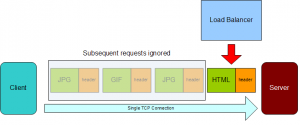
The other thing you need to do is fix the ACE’s attention span. You see, by default the ACE has a short attention span. The HTTP protocol allows you to make multiple HTTP requests on a single TCP connection. By default, the ACE will only evaluate/manipulate the first HTTP request in a TCP connection.

So your log files will look like this:

1.1.1.1 "GET /lb/archive/10-2002/index.htm"
- "GET /lb/archive/10-2003/index.html"
- "GET /lb/archive/05-2004/0100.html HTTP/1.1"
2.2.2.2 "GET /lb/archive/10-2007/0010.html"
- "GET /lb/archive/index.php"
- "GET /lb/archive/09-2002/0001.html"

The “-” indicates Apache couldn’t find the header, because the ACE didn’t insert it. The ACE did add the first source IP address, but every request after it in the same TCP connection was ignored.

Why does the ACE do this? It’s less work for one, only evaluating/manipulating the first request in a connection. Since browsers will make dozens or even hundreds of requests over a single connection, this would be  a significant saving of resources. After all, most of the time when L7 configurations are used, it’s for cookie-based persistence. If that’s the case, all the requests in the same TCP connection are going to contain the same cookies anyway.

How do you fix it? By using a very ill-named feature called persistence-rebalance. This gives the ACE a longer attention span, telling the ACE to look at every HTTP request in the TCP connection.

First, create an HTTP parameter-map.

parameter-map type http HTTP_LONG_ATTENTION_SPAN
  persistence-rebalance

Then apply the parameter-map to the VIP in the multi-match policy map.

policy-map multi-match VIPsOnInterface
  class VIP1
    loadbalance vip inservice
    loadbalance policy VIP1_L7_POLICY
    appl-parameter http advanced-options HTTP_LONG_ATTENTION_SPAN

When that happens, the IP address will show up in all of the log entries.

1.1.1.1 "GET /lb/archive/10-2002/index.htm"
2.2.2.2 "GET /lb/archive/10-2003/index.html"
1.1.1.1 "GET /lb/archive/05-2004/0100.html HTTP/1.1"
2.2.2.2 "GET /lb/archive/10-2007/0010.html"
1.1.1.1 "GET /lb/archive/index.php"
2.2.2.2 "GET /lb/archive/09-2002/0001.html"

But remember, configuring the ACE (or load balancer in general) isn’t the only step you need to perform. You also need to tell the web service (Apache, Nginx, IIS) to use the header as well. None of them automatically use the X-Forwarded-for header.

I don’t know if they’ll try to trick you with this in the CCIE Lab, but it’s something to keep in mind for the CCIE and for implementations.